
In Bagshaw Limited v Revenue Scotland [2026] FTSTC 4, the First Tier Tribunal (FTT) for Scotland found that two Category A listed properties in Glasgow, a Victorian townhouse and a mews building, were non-residential property for Land and Buildings Transaction Tax (LBTT) purposes.
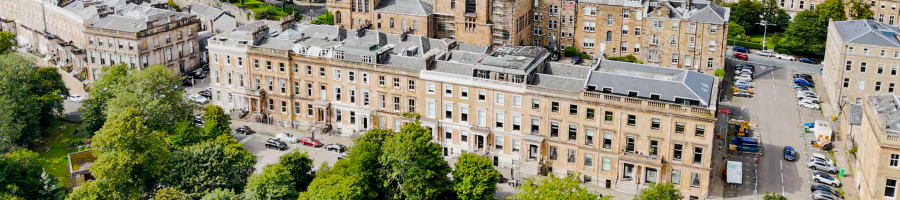
The appellant, Bagshaw Limited, purchased two interconnected Category A listed buildings in Glasgow on 17 December 2020: a townhouse at 19 Park Circus and a mews building at 22 Park Terrace Lane. The total consideration paid was £1,700,000.
- The properties had been built as residential accommodation in the Victorian era. Around 1920, they were converted into a nursing home (including an operating theatre) and remained as such until around 1937.
- The properties subsequently served as Archdiocesan Curia offices (1951-1964), an Archbishop's residence alongside office use (1965–1976), a Franciscan convent (1979–1999), and finally as offices for a charity until 2019.
- Planning permission for change of use from a convent to offices had been granted in 1998.
- The properties were listed on the non-domestic Valuation Roll and non-domestic rates had been applied.
- The charity vacated the properties in August 2019 when they were sold on twice, before being purchased by Bagshaw Limited. The properties were not used by either intermediate owners.
- Before purchase, Bagshaw Limited instructed Halcyon Reinstatement Services to advise on conversion to residential use.
- Halcyon confirmed that when first inspected in 2020, the properties were already uninhabitable and had been so for a long time: the plumbing, heating and electrical systems had been removed and there were no usable toilet facilities.
- An asbestos survey dated 7 December 2020 described the properties as commercial.
- The original Land and Buildings Transaction Tax (LBTT) return filed on 17 December 2020 classified the transaction as residential.
- LBTT of £228,250 (comprising £160,250 LBTT and £68,000 Additional Dwelling Supplement) was paid.
- A subsequent amended return claimed Multiple Dwellings Relief of £43,750, reducing total LBTT to £184,500.
- On 23 April 2024, Bagshaw Limited filed a repayment claim of £111,000 on the basis that the transaction should have been classified as Non-residential, which would have attracted LBTT of £73,500.
- Revenue Scotland opened an enquiry and subsequently issued a Closure Notice on 20 December 2024, upholding the residential classification. This position was confirmed on Review on 28 March 2025.
- Bagshaw Limited appealed to the First Tier Tribunal (FTT) for Scotland.
The sole question was whether the properties were 'residential property' within section 59(1) of the Land and Buildings Transaction Tax (Scotland) Act 2013 (LBTTA 2013). Were they a building 'used or suitable for use as a dwelling'?
The FTT found that:
- The legal framework was set out in Mudan v HMRC [2025] EWCA Civ 799, which considered the identical Stamp Duty Land Tax (SDLT) provision in section 116 of the Finance Act 2003.
- It was necessary to make an assessment by way of a multi-factorial evaluative exercise, with no single factor being determinative.
- The proposition that a building which begins life as a dwelling retains its residential character indefinitely was rejected.
- Although the properties were originally built as residential buildings, they had lost their identity as dwellings as far back as approximately 1920, when they were converted for use as a nursing home.
- The works to convert the properties into a nursing home and the subsequent works required to build the offices deprived the properties of their character as residential property. Use and occupation were then non-residential and the nexus with residential use was broken.
- Subsequent uses as Curia offices, a convent and charity offices did not restore residential identity.
- The properties had not been in residential use for many years. All the residential features had long since been stripped out, and no utilities were operational at the effective date of the transaction.
- Although there was residential use between the mid-1960s and 1976, it was mixed occupation as there was still office use.
- The convent use was not residential use for section 59 LBTTA 2013 purposes.
- Planning restrictions were a relevant factor in the multi-factorial assessment. The properties could not lawfully have been used as dwellings since at least 1998, when planning permission was granted for a change of use to offices.
- No planning permission for residential conversion had been obtained as of the effective date of the transaction. Permission was ultimately granted in April 2022.
- At the effective date of the transaction, the works required to render the properties habitable were extensive. There were no usable facilities, utilities had been removed or disconnected and the properties had been stripped back to the bare walls.
- This went well beyond the sort of repair or renovation that leaves a building's residential character intact.
- Having lost their residential identity many decades previously and requiring such extensive works to become habitable, the properties were not suitable for use as a dwelling within the meaning of section 59(1) LBTTA.
The appeal was allowed.
Useful guides on this topic
LBTT: Land and Buildings Transaction Tax
What is Land and Buildings Transaction Tax (LBTT)? What are the rules?
LBTT: Additional Dwelling Supplement
What is the Additional Dwelling Supplement for the Land and Buildings Transaction Tax? When does it apply?
Statutory Review by Revenue Scotland
What is a Statutory Review? What is an appealable decision? How do I request a review? What is the review process?
LBTT: Multiple Dwellings Relief
What is Multiple Dwellings Relief (MDR) for Land and Building Transactions Tax purposes? When does it apply and how is it claimed? What are the differences between MDR for SDLT and LBTT?
External link